Red cotton bug is serious pest of red silk cotton trees. The nymphs and adults feed on emerging bolls and seeds of cotton family/malvacae and reduce the germination capacity of seeds.
I hunted some okra looking seeds of red silk cotton tree/semal at a park in Gurgaon in the June beginning when trees were at the fag end of fruiting and found heavy infestation of semal bug all across the park. Bugs were feeding and breeding on the fallen pods/balls of semal tree.
For more information of tree, click and read down below link
Red-pumpkin-beetles are voracious eaters of cucurbits and munch newly germinated 2-4 leaves stage cucurbits just in no time before you witness the economical demage. They love eating melons and gourds.
Taming them is not rocket-science or you do not need to lead the chemical war, few cultural methods and management practices will keep them at bay. Don't panic, handle them peacefully and they really look charming by the way, right!!! You simply need to understand their behavior. Once you get to know, taming them is not really tough-game.
Their grubs remain in soil and start eating as cucurbits start germinated in the very early stage. They really relish the taste of all cucurbits except bitter-gourd. They might be not suffered from diabetes unlike human that they do not like eating bitter-gourd!!.
Few strategies to tame them
Sprinkle ash (dung ash/soft-wood ash) on germinated plants.
Soil solarization in hot-months to kill the grubs in soil.
Spray neem oil as precautionary method once in 3-5 days interval.
Manual collection and destructing them by putting under the soil in early stage.
Germinate seed ex-situ in nursery and transplant. Once plant start growing they don't feed much and plant has mechanism to bear the damage.
I am often being questioned to resolve the mealy-bug infestations in their aesthetic and food gardens by numerous people. Most of the time it is hibiscus/China-rose which is being infested and set the alarm bells ringing.
Pink hibiscus mealy-bug is serious pest of plants belonging to hibiscus/malvaceae family including edibles like okra and fiber cotton. This is major problem in warm-temperature days and in dry climate. It is pink coloured nymphs which suck the sap from plants. Even controlling mealy-bug infestations with harsh chemicals has been failed. The other way around applications of simple home-made/in-situ formulations do work well.
Why controlling/killing mealy-bug is challenging?
Simply, because it is thick-skinned insect with protective waxy layer/coating over the skin.
It is being devoid of fluid/blood means less watery.
Key to control
As mentioned it is being covered with thick protective waxy layer/coating and devoid of blood/fluid in body, application of alcohol and soap holds the key/Brahmastra. Alcohol would dissolve the wax layer and soap would penetrate and promote ex-osomosis, desiccating mealy-bugs to death.
Solutions/remedies
Wash/spray the infested plants with simply soap-water regularly. You may use 5 gm synthetic soap per liter water or boil 10-12 seeds kernels of soap-nut berries for organic soap water.
Take 100 gm rice powder 100 gm soap-nut powder/seed kernels. Get mixture boil in 1 liter water. Let it cool down and keep remain for minimum 3 days to ferment (rice starchy water would ferment to natural alcohol, right!!) Use 8-10 ml of solutions third day onward.
Mixture of 10 ml of drinkable alcohol and 50 ml concentrated soap-nut berries concentrated liquid could works well.
Mixed solution of 10 ml vinegar 10 gm jaggery/sugar per liter once in 3 days of water helps to ward-off ants from farming mealy-bugs (ants and mealy-bugs have symbiotic relationship. Ants help mealy-bug nymphs to transfer new branches and save from predator).
All solutions/remedies can be applied once in 3-7 days interval as per scale of infestation.
Historically, food has usually been grown both locally and in a decentralized system; in the form of kitchen/cottage gardens. Progressively we stopped growing food individually and began to trust the growing of safe and healthy food to someone else, or as the government’s responsibility.
Now that the major agricultural companies have demonstrated that they have no incentive to grow safe food or practice ecological sensibility, people are again reconsidering the value of growing their own food, using natural practices and traditional knowledge systems. We are witnessing a renaissance of food gardens, seed saving, converting kitchen biodegradable wastes into compost, cultivating indoor plants for fresh air and aesthetic soul-food, and even as part of school and community development programmes.
The emerging fields like biomimicry encourage us all to return to natural systems; this is not only useful for innovation in design but is also a lens to learn how plants grow naturally in a wide variety of ecosystems. There is an endless source of inspiration when we open our eyes to the brilliance of designs which nature has perfected through evolution over billions of years. Using nature’s guidance, we can grow a wide variety of food in a small space while also using less inputs — including physical labour.
Designing a system which imitates nature’s ability to decompose, store water and provide access to sunlight for as many plants as possible allows us to maximize our land, minimize our effort and ultimately yields far more tasty, healthy food — as well as medicine, fiber, fodder, fuel and producing clean air and water supply.
Designing low maintenance soil
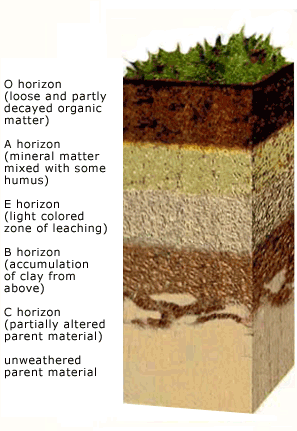
If we cut any piece of so-called-soil (the upper layer of earth) straight down, we observed multiple layers, formed over the course of time, called the soil profile/horizon as demonstrated in this image:
Image providing by EarthCache & Park Friendly Caching
Second on the forest floors, where leaves are falling from treetops constantly, as well as twigs, old broken branches, flowers, seed pods and all sort of natural materials, this ‘organic matter’ accumulates and over time decomposes into what we call humus (dark-brown amorphous complex carbon ‘dirt’). This humus is destined to become topsoil, a substance full of rich minerals and vitamins which also retains water. Through the process of decay, dead matter transforms into food for insects, bacteria and fungi — supporting the health of the soil and naturally sustaining the soil ecosystem.
These features of soil-profile and forest floor could be emulated to cultivate low maintenance soil where we can grow food in-situ or in containers where there is not a lot of land to grow our food. Such designs could be easily replicated in raised beds or hugelkultur beds or to design low maintenance containers for public and community gardens where land, labour and personal attention are often scarce resources.
Designing low maintenance containers
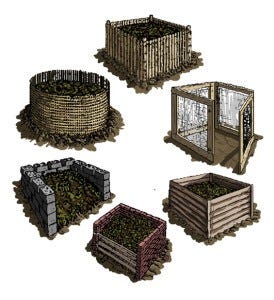
Examples of some containers where you may grow your soil.
First layer: Drainage.
At the bottom of your container, put a layer of gravel and small stones/pebbles. This promotes adequate drainage and keeps roots from being damaged in case of over-irrigation and heavy rains. Second, this layer anchors deep rooted plants and provides minerals for the plants. Depending on the size and depth of your container, the drainage layer can be about 5–10% of the total height of container by volume.
Second layer: Carbon
This is a layer of ‘dry matter’. Any carbon rich material including garden leaf-litter, farm residue such as dry grass clippings/chaff, softwood twigs, or activated charcoal could be used.
Third layer: Nitrogen
Materials rich in nitrogen and low in carbon, e.g. kitchen waste, peels, tea leaves, chopped green manure, and fresh-animal dung can be placed over the carbon layer.
As we want to design low maintenance containers which does mean in practice is a system of design which requires zero-till, maximum intervals between subsequent irrigations, requiring far less external fertilization (effective micro-organisms such as compost tea may still be used at intervals), and effectively no weeding (particularly in zero-maintenance-containers). So, carbon-nitrogen layers functions as the heart of these zero-maintenance containers by acting as a micro-soil-ecosystem collectively.
Carbon-nitrogen layers decompose over a brief period, and act as a regenerative micro-ecosystem in your container. Over time, the volume of these layers would shrink and develop cracks in the growing layer above; promoting natural tillage, aeration and soil-activity.
Together, the decomposed carbon-nitrogen layers would take up 20–30% of the total height container. These layers are harder to accommodate in shallow containers, so choose a design with sufficient depth.
Fourth layer: Growing Medium
The growing medium layer could be designed using readily available local soil, compost and soil-amendments (e.g. natural calcium or other minerals) in adequate proportion. This is the main supportive layer where seeds or plants are being sown. This layer will use 50–60% total height of the container.
Fifth layer: Mulch
Mulch sits above the soil, around the area where seedlings/plants are growing. Mulching has multiple benefits; it retains moisture in the soil, regulates temperature, minimises conditions for weeds to grow and prevents damage caused by natural elements. No forest floor is left bare: why should our fields or garden beds look any different?
To cover the soil, you may wish to sow very short edible plants e.g. fenugreek, spinach, nasturtium, coriander or microgreens. Edible legumes such as alfalfa and fenugreek are particularly useful as a bio-mulch, since these plants fix nitrogen in the soil for the other plants to enjoy.
Alternatively, you can sprinkle any organic material e.g. dry grass clippings, broken egg shells, dry leaves, chopped straw etc, which will break down and feed the soil with further nutrients.
What value can this design offer you?
Many herbs, vegetables and edible shrubs can be grown in zero-maintenance containers.
These biomimicked solutions can be deployed to design numerous containers and soil-mediums for urban food gardening where land, labour and personal attention is limited.
You don’t have to interfere so much; let nature do most of the work and simply support it by checking the moisture and occasionally adding more mulch, diluted worm juice or compost tea. Simple!
There are hundreds of thousands of seeds.
Many of us are not even able to recognise the corresponding seeds of the food
we eat. The average botanist could at most identify some hundreds of them.
While studying agriculture in university formally, I passed some practical seed
identification exams. I observed that seeds from the same family look quite
similar; even those who deal with them on daily basis might get confused. But
the beauty of the seeds is that they never lose their identity.
One thing all seeds share in common, no
matter how similar or different they seem from each other, is that once they’re
put in soil they manifest their true identity. They are tiny but living
supercomputers, with sophisticated genetic information and programming. They know
the best times to germinate, flower, fruit and mature, and accommodate biotic
and abiotic challenges. They have inherited sensors which sense the optimum
temperature, light, humidity and other external conditions to pick the best
moment to open their winged cotyledons and fly into the sky.
Traditional communities have always
revered their seeds. They protected them throughout the ages and passed on the
strongest, tastiest and best seeds to each next generation, which are what we
now call heirloom or native seeds.
During this process, seeds also remembered
and adapted to the local climate, rain, drought, pest attacks and other
conditions which occurred during their life. The intelligence of the plant
modified their offspring to better handle all these conditions. This is why
local and heirloom seeds are more resilient to climate change and adversities
of climate.
It is also being demonstrated that seeds
have many sense capacities; detecting conditions of the soil, climate change,
people who raised them and the micro-climate where they are grown. They are, in
fact, more intelligent and responsive than we tend to consider. You may notice
that often, acquired seeds take time to acclimatize to new places. Doesn’t it
seem meta-physical in nature, to consider that seeds are tiny but living
supercomputers?
Save your local traditional seeds
Ask your elders for the plants which have
survived the green revolution and allow them to continue optimizing for their
environment. Swap seeds with other local gardeners so that you’re able to grow
those which have been surviving and thriving under unusual and extreme weather
conditions. In return, they will be there to nourish us as climate conditions
become more and more unpredictable.
It is this relationship between the
farmer, the seeds and the land which creates abundance. Yet if we don’t respect
the intelligence of our collaborators, how will that affect us? Perhaps we
already see the answer playing out each season when crops are failing.
By cherishing the intelligence and genius
of the local seeds, we can improve these statistics and once again live in
flourishing communities with diverse, delicious and well adapted food crops.
It all starts by honouring the potential
and the intelligence which each seed bears.
Collect and share these tiny
supercomputers! Support their evolution so that they may support ours. They are
the greatest gift, and by respecting what they have to offer, we can again live
in reverence and enthusiasm for their wisdom and capacity for advanced
regeneration.
This piece is written by Vipesh Garg with editing and contributions by Naomi
Joy Smith.
Aphids are most common pest in our food gardens and farms. They are polyphagous in nature, feeding upon all range of fruits to tender flowers, and veggies to cereals through sucking sap.They are found in all different shades from black to brown, yellow to green. Their life cycle involves wingless females reproducing to winged females procreating innumerable young nymphs. The nymphs further proliferate extremely rapid and binge on plants. The wings develop later in the season for brief period of time, allowing the insects to fly-off and colonise on new plants.
Ants and Aphids In natural world, things look different from as they appear. There is suppose to be symbiotic/mutual relationship between ants and aphids. It has been studied that ants rear and protect aphids from being predation. They also sometime park aphids on safe places sometimes. But, at the same time it has also been observed that this generous act by ants performed to feed on honey dew, sweet honey like sticky substance secreted by aphids. This honey-dew is actually poo of aphids which is being secreted to repel the ants, but ants like it astonishingly. If ants do not feed on this sticky honey dew, it turns out to be breeding ground for sooty molds. So, ants also in someway help plants not to get infected with sooty molds/fungi. Interestingly, ants rear the colonies of aphids in the same way we rear and care animals in exchange of utilities.. Aphids and lady-beetles/lady-bugs The protagonist in the story is every kid's favorite insect lady-beetle/lady-bug which even ants could not save aphids from get predated. The tail-less-alligator like larvae of lady-beetles are voracious eaters and they continuously feed on the aphid population till they get exhausted. The University of Kentucky Extension Service reports that a single ladybug eats around 5,000 aphids during its lifetime. When larvae reach full growth they move to some safe corner of the leaves or stem and turn into non-feeding pupae. In a few days the pupa raptures and the young adult comes out to continue binge on aphid colonies. A single adult lady-beetle eats up to 50 aphids in a single day.
While they do such a great job free of cost, we often throw baby out of bathwater when we spray harsh chemicals to get rid of aphids. If we trust in nature, nature keeps check on such elements in her own way. So, lady-beetles keep check on aphids naturally. Further certain blossoming herbs and flowers provide the nectar and breeding ground for lady-beetles and lady-bugs, need for reproduction. These blossoming herbs could be anything from dill to cilantro, carom to cumin, fenugreek to fennel, parsley to celery. These herbs facilitate the colonies of lady-beetles/lady-bugs and also disrupts the mating of aphids because of their natural fragrance. For more and photo gallery click the link: http://www.pbase.com/antjes/lady_bug
Fragrance and smell has always remained integral part of communication since life exists. Who know well about it than teens and adults in schools and colleges emptying bottles of perfumes & deodorants to entice opposite sex-partners. Even smell of once's body is a factor of attraction in physical intimacy. You might be heard that wife caught her husband's physical relationship with someone else smelling husband's cloth/body. Anyway your mother might have caught your smoking habit while washing cloths if you smoke sometimes.
Not only fragrance and smell play important role in human relationships, it plays vital role in all kind of natural life exists around. Whole animal kingdom primarily insects communicate through chemical smells known as pheromones. At the same time it is extensively documented that plants also deploy chemical trails as communication channels along with mycorrhizal fungal networks as part of defense mechanisms.
Historically farmers have been observing these principles and mechanisms while growing food and to regulate insect-pest damages naturally using numerous permutations and combinations of plants (guilds). They have been observing nature keenly and, her way of doing and managing the things. Diverse set of designs and combinations operates in nature to regulate the life and destruction.
A diverse range of food herbs, flowers and oil crops have always been grown with pulses and grains in integration to keep soil infertility and various biotic damage at bay. This polyculture model promotes a lot of direct and indirect benefits from food self-sufficiency to no-use of harmful synthetic chemicals. Few leaves could be taken out of natural designs to grow food without harmful chemicals in fun way.
In this brief piece of information without much diverting I am trying to convince that such models/designs can be tried/experimented to grow food both at garden and farm level without deploying harmful synthetic chemicals. Designs simply include growing plants or a group of plants in such a combination (guild) that insect population remains below EIL (economical injury level) technically.
How it works? In nature life operates as a cycle of procreation and death. At lower rang of animal kingdom, particularly in insects, this play-game is more profound and intense. Insects reproduced hundred thousand of pro-genies in short period of life span. A small proportion of them reach to maturity just like a tree produced hundred thousand of seeds but very few reach up to matured tree.
Similarly maximum of insect babies get simply predated and used as someone other insect's food in hierarchy of wood-web. When diverse range of multi-crops are raised on a small plot or big-sized farm it attracts diverse range of insects where with crop damaging insects their predators come into picture in first place and, second numerous fragrant and smelly plants disturb the communication network/pheromone trails to check the reproduction rate. Some plants also attract particular type of insect predators to let them feed upon other crop damaging insects e.g. mustard, legumes (grams, fenugreek, peas) and coriander is being grown around wheat fields from ages.
In this bio-mimicked design mustard traps the aphid population and at the same time promotes the lady-red-beetle population (one lady red beetle eat around 5000 aphids in his life span roughly) to predate upon aphids. Coriander's fragrance hinders the pheromone induced mating mechanism operates in aphids to check reproduction rate. Legumes fix atmospheric nitrogen and act as ground cover, and thrive soil life. This is the simple example of linear design deployed by farmers traditionally through out ages but there are many such cyclic designs connecting with each other operates in natural eco-systems.
What you can do?
Little you can do try to bring maximum of diversity of crops/seeds into your food garden/plot using permaculture guilds.
Grow fragrant herbs and oil giving plants along with food crops, veggies and salads, and fruit trees (moreover you can make concoction of herbs and use them as pest repellent sprays).
Try to get hands dirty with practice of wild-gardening/natural farming/forest gardening.
Think how food is being grown in natural ecosystems without any human or technological intervention?
Read bio-mimicked designs/permaculture to grow food naturally with pledge to not use harmful chemicals damaging whole range of eco-systems.
Use native diversity of food and deploy traditional mechanisms of food growing being practiced in farms since ages.
What's take out?
Nature raise food using and deploying various cyclic mechanisms for numerous life-forms unlike modern linear food-system.
You can grow healthy food as fun and without any use of synthetic-chemicals bringing-in diversity of food.